|
Landscape
/ Background
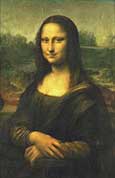
The entire background
of the Mona Lisa is a landscape. The subject is not placed under
an open sky. Compared with other portraits, the Mona Lisa takes
in the greatest distance, the most water, the densest atmosphere,
the loftiest peaks. It also seems to be more than just a background,
to be a additional imposing presence within the picture, the expanse
and curvature indicating no mere scene but a portion of the globe
itself.
Leonardo da Vinci provided
the Mona Lisa with a background that is every odd, although not
so often discussed, as the famous smile. It is a two-storied structure,
like one of those double churches in which Gothic builders sometimes
indulged their talents for the unexpected: below there is a relatively
- or formerly - human landscape, with a bridge that spans a partly
dry riverbed and a road that winds to a hidden end through hot
reddish brown rocks; above there is a frosty region with two glaucous
lakes, or sea inlets, and a mountain range whose jagged spires
vary from olive green to light blue and finally become transparent
in the flooding light of the distant horizon. One can be reminded
of the Italian Alps and of parts of Tuscany, but there is no point
in seeking a real location, for obviously this is an assembled
landscape (McMullen, 91).
One might imagine that
Leonardo considered adding indications of greenery to the background
or a verifiable emblematic detail, but as it is, the landscape
has little to do with the sitter herself than with the artist's
desire to elaborate the composition, and, perhaps to enhance the
beauty of the figure by way of contrast, such as the welcoming
look on the face and the forbidding look of the scenery.
The blue mountains
appear to recede into the vaporous distance according to the rules
for aerial perspective. The space of the landscape itself, except
for the aerial perspective at the top, is astonishingly unsystematic;
there are several possible vanishing points, and there is no regular
recession to provide clues to the relative sizes of the rocky
features. Actually, the whole panorama can be read as simply a
combination of distinct landscape bands, brown below and blue
above, and the illusion of a vast expanse is due to the superposition
of the bands rather than to any serious use of the optical principle
of the convergence of the preceding parallels (McMullen, 109).
Beneath the problems
of execution and temperament there may have been one of philosophical
outlook, for although Leonardo certainly thought himself as a
realist he seems to have been uncertain about the exact kind of
realist he was. In his mathematical moods he was ready to argue
that reality was an inflexible structure of laws and harmonies
and that painting compels the mind of a painter to transform itself
into the minds of nature itself and to translate between nature
and art, setting out, with nature, the causes of nature's phenomena
regulated by nature's laws.
Choice
of lighting
Faint illumination.
Near twilight depicted in the Mona Lisa. Leonardo favored this
type of lighting for portraiture.
The responsiveness
of the Mona Lisa to changes of lighting is unusual, perhaps unique.
The Mona Lisa suffers little under light-adapted vision and gain
little under dark adaptation. By contrast, the degree of change
in the tonal range resembles that which occurs with a natural
object.
Painting
style and other formal elements
Leonardo explains color
perspective this way, ". . . through variations in the air
we are made aware of the different distances of various buildings.
. . therefore make the first building. . . its own color; the
next most distant make more blue. . . at another distance bluer
yet and that which is five time more distant make five times more
blue." This principle is demonstrated in the background of
Mona Lisa: the ground and hills directly behind the subject are
painted in warm tones of reddish browns and tans. As the landscape
recedes the mountains and water become progressively more blue.
Leonardo also noted that air is more dense closest to the earth,
therefore the bases of hills will always appear lighter than the
summit; he applies this theory to the hills behind the sitter's
shoulders which start out a tan color and become dark brown (Kemp,
83-84).
His study of shadow
can be related to his works in both compositional arrangement
and in sfumato** techniques, which
are both demonstrated in the Mona Lisa. One method of composition
employed by Leonardo involved focus and blur. In the Mona Lisa
Leonardo uses shadow in the lowest areas of the picture plane,
at the edges, and background of the landscape to blur detail and
draw attention to the detailed focus area of the face. Leonardo
also uses shadow as a primary element in creating sfumato or soft
focus, which creates the illusion of volume by allowing light
to emerge from the darkness of shadow. The sitter's body in Mona
Lisa emerges from the shadows surrounding her from the mid arm
area down. Her hands are areas of light that emerge form the blurred
shadows of her body and her face emerges from darkly shadowed
areas of hair and veiling. Leonardo's study of the shape of shadow
contributed to the blurred shadow edges that are a hallmark of
the sfumato style. The Mona Lisa's body and face are enclosed
within shadow, but no shadow edges ever become evident (Dunning,
82).
In the Mona Lisa the
subject comes closer to the front edge of the picture than had
been customary hitherto: this smaller distance between sitter
and viewer heightens the intensity of the visual impression while
the landscape suggests greater spatial depths and atmospheric
intensity. Craggy mountains disappear into the distance against
a greenish-blue sky. On the left we can make out a stream and
on the right we can see what looks like a dry river-bed, although
it is not possible to tell quite how this connects, if at all,
with a reservoir higher up. Individual outcrops in the landscape,
bereft of vegetation, are reminiscent of similar rock formations
in religious pictures that Leonardo had begun not long before.
Indeed the formal affinity between this work and depictions of
the Madonna cannot be dismissed, as is frequently the case in
Renaissance portraits of women. The Mother of God was regarded
as the ideal to which every honourable woman would aspire, and
this is reflected in the formal parallels between depictions of
the Madonna and portraits of women. Even the smile of the Mona
Lisa is related to the smiles of St Anne and of the Virgin: indeed
a smile of this kind was part of the standard repertoire of painters
in the late 1400s and early 1500s. In addition, the Mona Lisa's
smile also matches contemporary views on feminine charm: the beauty
of a contented, modest female smile was a reflection of that woman's
beauty and, hence, also of her virtue. Beauty was taken in those
days to be an expression of virtue, external beauty was an embellishment
of virtue - as demonstrated earlier by Leonardo in his Portrait
of Ginevra de' Benci (Zöllner).
**Sfumato
is the famous invention of Da Vinci - light and shade that allow
one form to blend in with another leaving something to the imagination.
He did this to the corners of Mona Lisa’ mouth and eyes which
explains why she may look different and different times.
|


 Did you know?