|
The story is told of two women from the countryside, standing
in front of the Mona Lisa, and saying to each other, "I don't
like it." "What's all the fuss about?"
The guard says, "Ma'am,
the Mona Lisa has stood the test of time. When you stand before
her, it is you, not she, who is being judged."
Like so many things
nowadays, the Mona Lisa is famous mainly for being famous.
Behind the mystique
of the Mona Lisa is the mystique of Leonardo da Vinci and the
Renaissance. Leonardo, more than any other, has come to symbolize
the Renaissance--the seer, the seeker of knowledge in many fields,
the heroic old wise man.
There is some doubt about the actual date of the painting, with
some authorities holding out for 1504, some for 1513-16, and some
for a long gestation that may have included sketches before 1504
and completion around 1515. Much information comes from Giorgio
Vasari's short biography of Leonardo da Vinci, written around
1550, unfortunately rife with errors.
There is some doubt
about the identity of the woman in the painting, too. The earliest
answer, from 1517, is that she was merely a "certain Florentine
lady," but Vasari specifically identifies her as Mona Lisa,
the wife of Francesco del Giocondo (Mona is from madonna meaning
Mrs.). Regardless of the true identity of the sitter, Mrs. Giocondo's
name is commonly associated with the painting, referred to in
English-speaking countries as the Mona Lisa, in Italy as La Gioconda,
and in France as La Joconde.
However, Leonardo did
not mention Mrs. Giocondo, but referred to Giuliano de' Medici.
Sixteenth century inventories at Fontainebleau listed the work
as a picture of "a courtesan in a gauze veil." So, we
add an element of mystery to the Leonardo mystique.
Over the centuries, a number of other women have been put forth
as the model, including a suggestion that Leonardo used himself,
looking in a mirror (so right/left reversed), as well as the notion
that she was painted from Leonardo's imagination, with no particular
model in mind. Larry Feinberg, Ryan curator in European paintings
at Chicago's Art Institute, says that consensus today is pretty
much in favor of Mrs. Giocondo. She would have been in her late
20s or early 30s at the time.
Leonardo did not give
the painting to the Giocondo family, but kept it himself, and
took it with him to Milan, Rome, and France, and used it as a
"calling card," says Feinberg--sort of an advertisement:
"Hey, look what I painted! I can paint for you, too!"
So in addition to being a mystery, the painting was also something
of a publicity gimmick, from its earliest days.
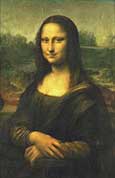
The Mona Lisa revolutionized
painting. The pose itself broke tradition--previously, portraits
were invariably full length. Leonardo introduced the waist-up,
hands-folded-on-lap approach, which allowed for a much more intimate
treatment. The pose was imitated immediately and became fashionable
for portraiture by such painters as Raphael. The background is
painted in a gradation of lights and colors, losing details in
the distance, instead of the traditional approach in which foreground
and background are equally distinct. Mona herself is rendered
with extraordinary vividness--one has a sense of viewing the living
woman. (The effortless realism of photography has perhaps diminished
our capacity to appreciate this.) Leonardo displayed in this work
a mastery of technique that was unknown at the time, profoundly
impressed his contemporaries, and has seldom been equalled since.
OK, so we have the
mystique of Leonardo, the early mystery and publicity, and to
that we add an artistic revolution--all qualities that contributed
to the Mona Lisa's growing fame.
In the 1530s, the painting
was acquired by Francis I, King of France, and kept at Fontainebleau,
where it was seen by dignitaries and upper levels of society.
Early viewers were startled and dazzled at the illusion, commenting
on how alive she looked. An account from 1550 mentions "a
smile so pleasing that it seems divine rather than human."
In 1625, the Duke of Buckingham tried to acquire the painting
for England, but several people appealed to the French king that
he would be losing "his most beautiful painting out of the
kingdom." By that time, it had long been famous.
In the time of Louis
XIV (late 1600s), there were copies, some good enough to have
at one time been attributed to Leonardo himself--including versions
of a nude Gioconda (there were rumours that Leonardo had himself
painted a nude version).
In the 1650s, the Mona Lisa was moved to the Louvre, then a royal
residence. During the 1700s the work was kept in the king's private
collection away from public view, a state of affairs that a 1747
pamphlet deplored. When the Louvre became a museum in the late
1700s, the Mona Lisa remained hidden in "badly lit little
room." By 1800, it was hanging in Bonaparte's bedroom in
the Tuileries (he called it "Madame Lisa") where it
stayed until 1804 when it was moved to the Grande Galerie of the
Louvre.
"During the nineteenth
century the Gioconda myth ripened into an outre lushness, like
a giant orchid in damp moonlight," McMullen writes.
Accessible to the public
once again, the painting became a popular hit. This was the great
Romantic era, and Leonardo was again a hero. McMullen quips that
"Leonardolatry encouraged Giocondolatry." The number
of painted copies and engraved reproductions multiplied. Writers
and poets from the Marquis de Sade to Jules Michelet referred
to her; for example, George Sand described a character as having
"a certain smile, mysterious like that of Mona Lisa, which
she had on her lips and in the corner of an eye." She was
called a femme fatale, adding intrigue and passion to an already
heady mix. By the mid-1800s she was an icon, the most celebrated
painting in the world, famous for being famous.
Her fame became transcendent
in 1911, when the painting was stolen from the Louvre. There was
a public outcry, focused on how poorly such treasures were guarded.
Rewards were offered, amidst banner headlines of shock and mourning,
in the worldwide press. Newspaper accounts of the theft gave her
enormous familiarity at all levels of society. If you knew only
one painting, that painting was the Mona Lisa.
When the police got
nowhere in their investigations, the public attitude gave way
to mockery: cartoons showing her eloping with Leonardo, or thumbing
her nose at France. There were Gioconda radiator caps for motorists,
a Gioconda waltz, films -- McMullen cites a German farce in which
bumpkins mistake a vacationing woman for the missing celebrity
and forcibly ship her to the museum. The Paris mid-Lent parade
had a float of Mona Lisa taking off in an airplane. Music hall
and theatrical stars were photographed in the Mona Lisa pose.
Just about the time
the furor died down, the painting was found in Italy and returned
to France in the autumn of 1913. The return was a royal progress,
with stops along the way for exhibitions. Mona was a sensation
once again. Songs were written about her. New years's greeting
cards displayed her. There was a postcard labelled "Her Return"
showing the thief and the Mona Lisa, holding a baby.
This mockery was not
entirely new; there had been elements of it in the late 1800s.
But following World War I, both the painting and the mystique
became fair game and were widely exploited. The Dadaists viewed
her as a cultural fetish of the bourgeoisie. Marcel Duchamp painted
a mustache and a beard on a reproduction, and called it "L.H.O.O.Q."
(a pun on elle a chaud au cul, she has a hot ass.) Aldous Huxley
wrote a short story, "The Gioconda Smile," deflating
the heroine of Romantic fiction. There was a German opera about
Lisa as the femme fatale with several lovers, who eventually murders
her jealous husband Francesco del Giocondo. Nat King Cole sang
about her in 1950. She appeared as a photograph negative, with
a Salvador Dali moustache, wearing an owl mask, as a vampire,
with Stalin's face. She had become a familiar theme, and artists
of all sorts tried their hands at re-forming her or commenting
on her.
That commercial exploitation continues. The big sales campaign
started in 1911, at the time of the theft, and has expanded steadily.
By the 1970s, there were Mona Lisa nylon underwear, Mona Lisa
T-shirts, sweaters, scarfs, compacts, hairpins, jigsaw puzzles,
plates, dishtowels, wastebaskets, depilatories. In Paris, you
could eat at the Mona Lisa restaurant or the Cafe de la Jocondo.
She advertised cigarettes, cheese, and Joconde oranges imported
from Spain.
In 1963, she spent
seven weeks in the U.S., seen by over a million and a half viewers.
In 1974, over two million people saw her on a tour in Tokyo and
Moscow. Tokyo bars and shops changed their names to Mona Lisa,
a nightclub staged the world's first Mona Lisa Nude Revue, and
her face (with smile turned to a frown) was used as a poster in
a political campaign against government policy. In Moscow, viewers
left poems and flowers in front of the panel, as if she were a
sacred image.
Harriss says that the
Mona Lisa today "is in the paradoxical situation of being
both the symbol of Art and the inspiration for kitsch."
So that is the nutshell
history of the mystique, and some of the elements that contributed
to it. But now we are back where we started: how do we explain
this incredible fame?
Hard to say, in the
end. Inertia is part of it. Once the popularity ball starts rolling,
it keeps rolling. McMullen says, "The effect of momentum
should also be remembered: as in all sorts of stardom and best
selling, the success of the Mona Lisa reached at a certain indeterminable
point--somewhere in the middle of the nineteenth century--what
can be called a cultural orbiting speed, and after that it had
little need for fresh impetus." He comments at length on
the exhibition facilities, dominant artistic criteria, shared
cultural attitudes, and fashions in sensibility over the centuries.
Let's not overlook
the painting itself--the technique, the tone values. McMullen
says Leonardo was a wizard, who "combined optics with legerdemain,
actuality with artifice, matter with spirit, and the natural with
the supernatural."
There are other theories
and explanations, each more esoteric and scholarly and unfathomable
than the other, such as Andre Malraux who thinks the Mona Lisa
combines Greco-Roman and Judeo-Christian ideals into "the
Eternal Feminine." Uh-huh.
Interesting as the
explanations are, they ultimately fail to answer the question
you have posed -- why this particular painting? There were other
masterpieces that might have had such a career; why has this one
alone held the spotlight for nearly 500 years?
Larry Feinberg from
Chicago's Art Institute attributes it to the idealization, the
mystery, the ephemeral, otherworldly quality of the painting.
McMullen adds the interesting twist that the Mona Lisa was more
open to interpretation than any competitors. "The work stimulates
analogy through its intense ambiguity, its sense of mystery. .
. . It was, and still is, one of the supreme examples in Western
art of sheer availability for meaning, [inviting] the viewer-reader
to discover for himself, perhaps invent, what is signified."
Harriss quotes Jean
Magrat, president of the Friends of Mona Lisa, a club of serious
collectors of Gioconiana, as saying, "Frankly, I don't much
like that painting. To me it's not expressive and it doesn't look
like a real person. But I guess it's timeless, hélas."
- SDSTAFF Dex
Straight Dope Science Advisory Board
|




 Quote
Quote