|
These pages encapsulates
how a simple painting, an object, has been able to move people.
A painting is as good as non existent if no one cares about it
or appreciates it -- a tribute to all those who stood in four
hour long lines to just get a quick glimse of the Mona Lisa and
also to all those who recognise the legacy and significace of
this painting.
|
Mona
Lisa Song
by Livingston and Evans Recorded January 7, 1958
Mona
Lisa, Mona Lisa, men have named you
You’re so like the lady with the mystic smile
Is it only ‘cause you’re lonely they have blamed
you
For that Mona Lisa strangeness in your smile
Do
you smile to tempt a lover, Mona Lisa
Or is this your way to hide a broken heart
Many dreams have been brought to your doorstep
They just lie there, and they die there
Are you warm, are you real, Mona Lisa
Or just a cold and lonely, lovely work of art
|
Mona
Quotes
(Of the Mona Lisa)
She is older than the rocks among which she sits; like the vampire,
she has been dead many times and learned the secrets of the grave.
Walter Pater - Studies in the History of the Renaissance (1873)
Curiosity and the desire for beauty - These are the two elementary
forces in Leonardo's genius; curiosity of ten in conflict with
the desire for beauty, but generating, in union with it a type
of subtle and curious grace. Walter Pater - Studies in the
History of the Renaissance (1873)
(Of Leonardo's Mona Lisa) What voluptuousness…so like the
seduction by the violins in the overture to Tannhauser.
Maurice Denis - "Definition of Neotraditionism (1890)
The smile of La Gioconda was for too long, perhaps, the Sun of
Art. The adoration of her is like a decadent Christianity - peculiarly
depressing, utterly demoralizing. One might say to paraphrase,
Arthur Rimbaud, that La Gioconda, the eternal Gioconda has been
a thief of the energies. André Salmon, La jeune peinture
francaise (1912).
(Of the Mona Lisa) Her hesitating smile which held my youth in
a little tether has come to seem to me but a grimace and the pale
mountains no more mysterious that a globe or map seen at a distance,
a sort of riddle, an acrostic, a poetical decoction, a ballade,
a rondel, a villanelle or ballade with double burden, a sestina
or chant royal. The Mona Lisa (is) literature in intention rather
than painting - George Moore, Wale, (1914).
Comments:
The facial type that
appears in the Mona Lisa is a type that appears in art preceding
Leonardo's work. The conception of the Mona Lisa including the
smile is an extension and development of this facial type.
It can clearly be seen
in many of the works of Verrochio, Leonardo's master. The facial
type can also be traced back to medieval sculpture and the work
of some of the Flemish artists of the 15th century. This of course
in no way diminishes the achievement of Leonardo. His conceptual
and stylistic accomplishments are extremely important in the development
of art. Leonardo consciously worked at recording emotion and personality
in his drawings and portraits of people. Very few artists even
today can convincingly do this. Leonardo's Mona Lisa presents
a conception of three dimensional reality that was extremely advanced
for his time. In the painting he realizes form on a two dimensional
surface in a way that had not been accomplished before. The "reconstruction"
of three dimensional space and form created by Leonardo in this
and other paintings creates an eerie, mysterious atmosphere. It
looks real, but its not the three dimensional reality that we
live in.
- Mike
Cody
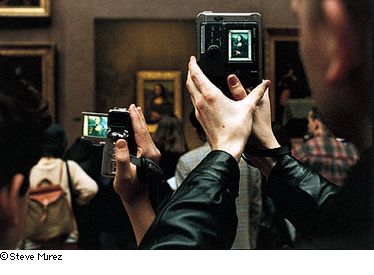
At the
Louvre, videocam-toting tourists, throng around Leonardo da Vinci's
masterpiece, hustle to capture an image of the museum's eternal
superstar.
I think that the Mona
Lisa painting is quite unique. There are many different aspects
of the painting and the smile I do find most intriguing. The smile
is very different in many ways. I think the painting is not a
big mysterious painting at all. There are many logical explanations
for it that many come up with but, of course, I do believe that
the smile simply reflects what Leonardo Da Vinci was feeling or
simply what he likes to see.
People often take a
simple thing and turn it into a big debate. Why don't they just
think reasonable for once? It is a theory that people create things
the by the way they were feeling. If someone is sad then they
paint or draw or sketch something sad. the same goes for many
other emotions. So, I don't know how many people will agree with
me on this one, but hopefully they will. Any painting reflects
the mood of the creator and in this case he was feeling happy.
- Hannah
Square-Hill
Theories:
A new theory about
the Mona Lisa advanced and articulated by
Dr. Margaret Livingstone.
(http://library.thinkquest.org/13681/data/links/mlsmile.htm)
"Mona
Lisa Anew" - Living oil on canvas
by Richard Krause
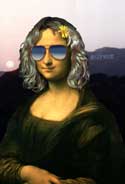
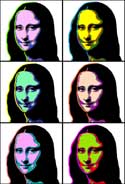
Mona
Lisa Images for the Modern World "A Giocondophiliacs
Delight" by Robert Baron.
I think she is Beatrice,
the wife that the great Dante praised more than any human could
ever have been praised in the third book of THE DIVINE COMEDY:
THE PARADISO. If you have ever read this classic, it is unbelieveable
how much he praises Beatrice. Now Da Vinci (being Italian just
like Dante) would have been heavily schooled in Dante and this
could well be a tribute to Beatrice.
- Rob Wade
"Mona Lisa's Secret Revealed " - published in the Brown University Faculty Bulletin, Dec. 2002
by Dina Q. Goldin
|




 Did you know?